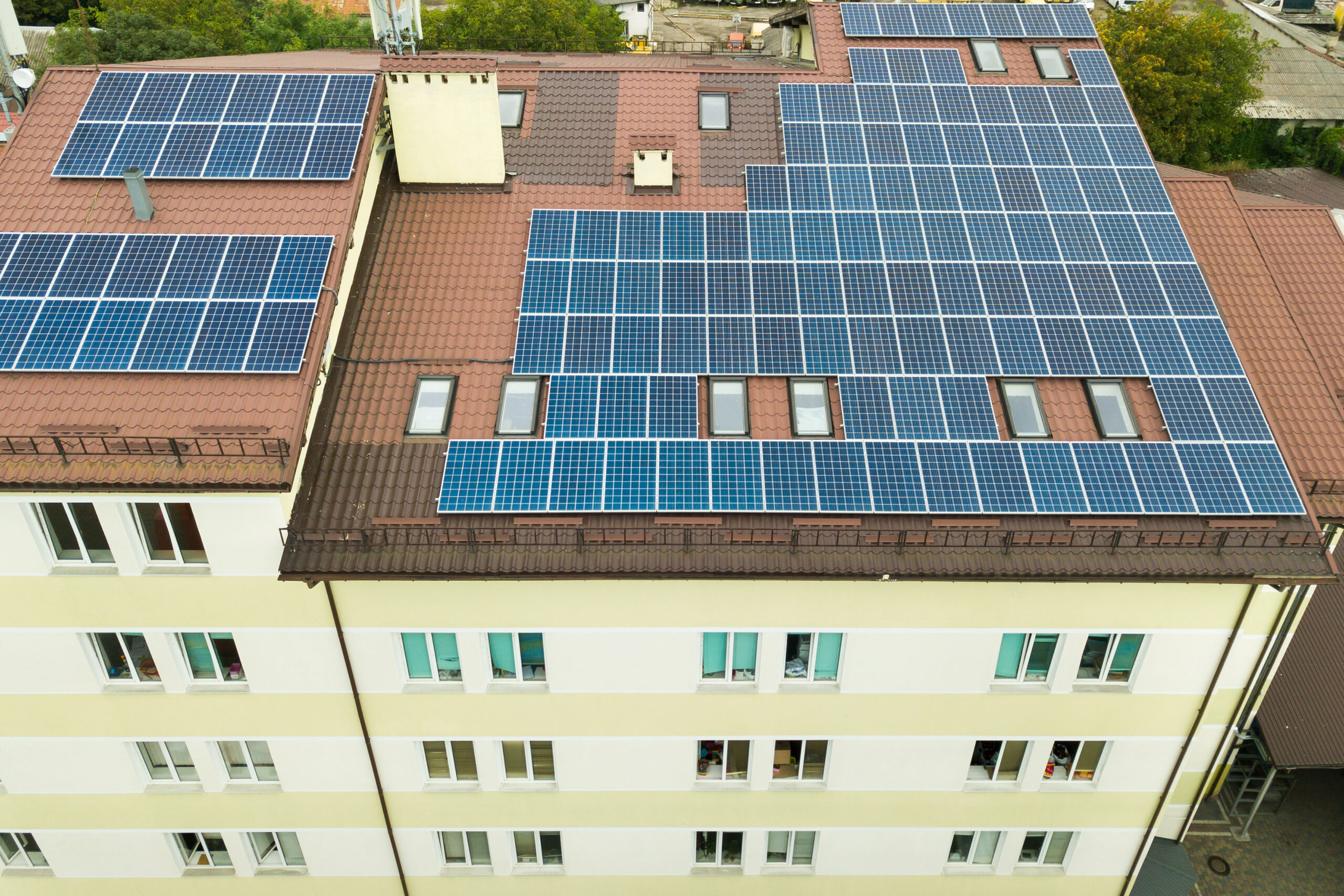
Business owners can install solar panels at their business to harness the sun’s energy to power your business with solar power. You can choose to install solar panels on either the roof or the grounds of your property. Solar panels are designed to capture the sunlight and turn it into electricity that can power your business and reduce the amount of electricity you buy from your utility company. For more information on how solar works, visit our Learning About Solar page.
Before you consider installing solar at your business you should confirm that your interconnecting electric utility supports solar installations. For more information on whether your business is eligible for a solar installation, visit our Is Solar Available in My Area page.
Additionally, to install solar at your business you will need to either own the building that houses your business or have a long-term lease that permits you to make improvements to the building. If you do not own your building, please contact your landlord prior to making any decisions regarding a solar installation.
There are many reasons why installing a solar energy system at your business is beneficial but there are also considerations you will want to contemplate prior to making this decision.
Why install solar?
One of the main reasons you may want to install solar at your business is to lower your monthly electric bill.
When you power your business with electricity produced using your company’s solar system, you will be taking in less power from the utility grid, meaning you will be paying your utility less for electricity, though the cost of the solar panels should be factored in as well (see [link] Cost of Solar and Solar Financing below). In many cases, businesses that choose to install solar are eligible to enroll in net metering with their utility. You should contact your utility provider to confirm they offer net metering before you enroll.
Other benefits to installing solar include reducing your environmental footprint. Businesses that install solar panels demonstrate a commitment to the environment, which may also bolster their business.
Is your business suitable for solar?
Before you make the decision to go solar you should consider whether your business is a good fit for a solar installation. Some of the main factors to consider are:
- The age of your roof – A typical solar system will last between 20-25 years. Therefore, if you plan to install panels on your roof and your roof is nearing the end of its life, you may want to consider replacing your roof prior to installing solar panels on top of it.
- The direction your home faces – The orientation of your building, and therefore the orientation of solar panels mounted on your roof, impacts the amount of electricity your solar system can produce. Ideally, systems installed in Delaware should be south-facing to receive the most sunlight.
- The tilt of your roof – The optimal tilt for solar panels is between 30 and 45 degrees from horizontal (flat). When solar panels are installed on a roof, they will follow the tilt of your roof.
- The shade on your property – Roofs that have minimum obstructions will be best suited for solar installations. If your business is heavily shaded by trees, surrounding buildings, or other obstructions it may not be a good fit for solar.
Cost of Solar and Solar Financing
The cost of installing a solar system at your business depends on many factors including the size of your building, your annual energy usage, the quality of equipment, and the installer you select to perform your installation.
There are three main options for installing non-residential solar: 1) purchasing a system 2) leasing a system 3) entering into a power purchase agreement, or “PPA”. If you lease a system or enter into a PPA you do not own the system, but you may still benefit from hosting the solar system at your business. Please visit our Owning vs. Leasing Solar page for more information.
In Delaware, there are grants available to offset the upfront cost of installing solar at your business. Non-residential solar systems are also eligible for the Federal Investment Tax Credit (ITC). Please visit our Solar Grants, Incentives & Financing page for more information.
Additionally, in Delaware you can sell your SRECs (Solar Renewable Energy Credits) through various SREC purchase programs to help offset the cost of going solar. Please visit our SRECs page for more information.
If you are interested in installing a battery backup along with your solar system, this will add an additional cost to your solar installation. For more information on battery backups, please visit our Battery Backups page.
Solar Installation
If you have made the decision to go solar, the first step will be selecting a solar installer to complete your installation. To learn the best practices for selecting a solar installer, we recommend visiting our Consumer Protection page. For a list of Delaware solar installers and their contact information, please visit our List of Delaware Installers.
In most cases, you will want to install a solar system that will generate enough electricity to offset your annual electricity usage. Once you receive quotes from solar installers, we recommend you run them through our Solar Calculator to verify the prospective systems will generate the appropriate amount of power.
To better understand the various steps of the solar installation process we recommend you review our Delaware solar installation timeline.